Situation
During a paid research internship at the LSP Research Group at NUS, I joined a PhD student's startup, EigenSensor, to demonstrate the real-world potential of their wearable EEG brain-computer interface (BCI), Nuance EEG Sensor. The startup needed a compelling end-user application to show the hardware could integrate with emerging technologies like VR — and I was brought in to propose and build that proof-of-concept.
During a paid research development internship at the LSP Research Group at NUS, I supported a PhD student's startup, EigenSensor, around its flagship wearable electroencephalography (EEG) brain–computer interface (BCI), Nuance EEG Sensor — a wearable sensor capable of reading user's hidden mental states like focus or relaxation, based on electrical activity in the brain.
While the hardware showed technical promise, the project lacked:
- 01Compelling end-user applications
- 02Proven compatibility with other platforms like VR
Given my HCI background, I was brought on to propose an innovative end-user use case for the PhD's BCI hardware. Given the unique strength of EEG-BCI to reveal users' hidden mental states based on their brain activity, and existing pain-points of meditation app users who struggle to track the effectiveness of their practice in real-time, I proposed building a VR-based EEG-BCI product — allowing users to engage in immersive meditation while receiving real-time feedback on the effectiveness of their practice, and demonstrating the potential of the novel hardware to integrate seamlessly with other technologies.
The environment was highly ambiguous: the EEG BCI was still evolving, documentation was minimal, and no one on the team had prior VR development experience. But I set out with full enthusiasm to realise the proposed idea.
Task
I was solely responsible for designing and building a VR-based focused attention meditation application that used the EEG BCI to read users' brain alpha-waves in real time and adapt the virtual environment to reflect their mental state, establishing the full communication pipeline between the EEG hardware, Python signal-processing layer, and Unity VR system from scratch.
My responsibility was to independently design and develop a VR-based neurofeedback meditation application that:
- Read users’ brain alpha-wave activity in real time through a wearable EEG BCI
- Build an end-to-end communication pipeline between the EEG BCI, signal-processing scripts, and VR headset
- Design an adaptive multimodal VR environment where visual and auditory stimuli dynamically responded to users’ mental states
- Validate the feasibility of integrating the Nuance EEG BCI with immersive XR technologies
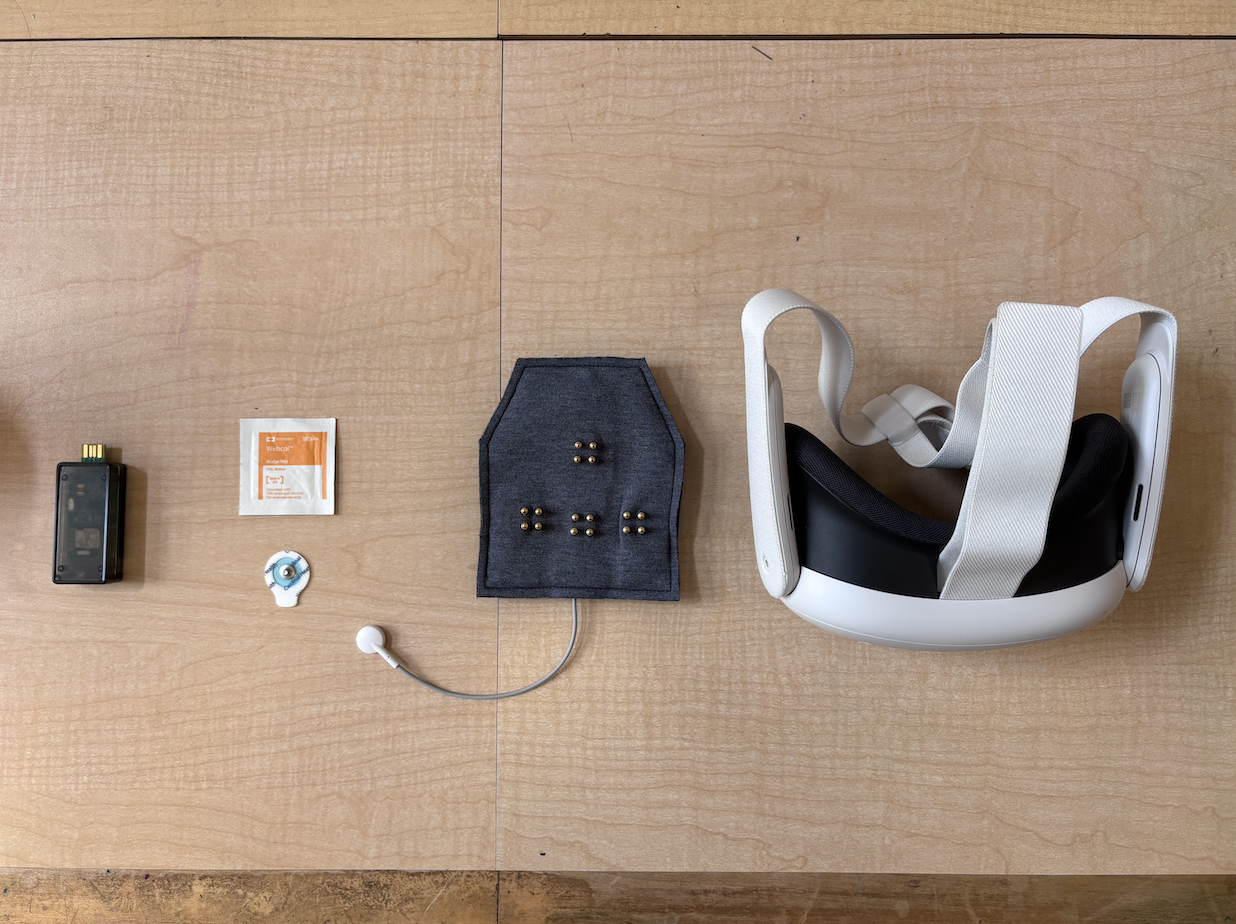
(hardware provided)
Actions
I self-taught Unity VR, OpenBCI, and MQTT communication while holding weekly sessions with the PhD student to understand the hardware's undocumented limitations. I designed the VR environment to protect signal integrity — adjusting tree billboard distances to prevent spurious EEG spikes and tuning campfire stimuli for optimal focus. When testing revealed each user has a unique brain alpha-wave baseline, I added a personalised calibration module, then validated the full system with 3 participants.
Built an end-to-end EEG ↔ VR pipeline
- Self-taught Unity VR development, OpenBCI integration, and MQTT-based real-time communication
- Worked directly with the PhD student to understand and debug the minimally documented EEG-BCI hardware
- Developed a real-time MQTT pipeline connecting EEG-BCI hardware signals to VR headset via an intermediate laptop
Designed around physiological signal integrity
- Reduced spurious EEG fluctuations — Increased tree billboard transition distance to minimize abrupt visual discontinuities during head movement, reducing unintended signal spikes while improving environmental fidelity
- Balanced stimulation intensity — Tuned campfire particle effects and spatial audio to maintain a "Goldilocks zone" of engagement — stimulating enough to sustain focus without overwhelming the calm mental state the system aimed to reinforce
Conducted pilot validation
Results
All 3 participants successfully completed the focused-attention neurofeedback protocol. I delivered the project in 3 months, ahead of the 4-month contract, independently conducted usability testing, and produced a product demo video. Both the PhD student and Professor Peh Li-Shiuan expressed strong satisfaction, and we remain in contact to this day.
- Completed the 4-month contract within 3 months
- Additionally conducted usability testing to guarantee desirable usability across users — going beyond the original scope to ensure the system worked reliably for people other than the developer and the PhD student
- Additionally produced a product demo video documenting the application's full functionality for the startup's future product demo and pitch
- Both the PhD student, Goh Teck Lun, and the head of LSP research group at NUS, Professor Peh Li-Shiuan, expressed strong satisfaction with the results — and we have remained in contact to date
- Delivered a functional proof-of-concept EEG-to-VR immersive neurofeedback meditation application built on EigenSensor's own custom EEG BCI hardware, ready for future demos and investor and customer pitches
Demo — Breathe neurofeedback VR prototype
Key Takeaways
This project built my capacity to rapidly self-learn unfamiliar technical domains, operate independently in underdefined research environments, and build end-to-end systems spanning XR, physiological sensing, and real-time data pipelines.
Through this project, I strengthened my ability to:
- Rapidly learn unfamiliar technical domains
- Operate independently in underdefined research environments
- Build end-to-end systems spanning XR, physiological sensing, and real-time data pipelines